Date:2026-10-27
A load schedule says 150 kW of essential load must stay on when the mains drop, and the buyer of a Dual Power Automatic Transfer Switch finds only a short list of current ratings to choose from: 100, 160, 250, 400 and 630 A. The steps between them are wide, so the choice is rarely as simple as "the next size up". A few lines of arithmetic show why.
On a 400 V three-phase supply, the current is the power divided by the square root of three, the voltage, and the power factor. The table assumes a power factor of 0.85 and no allowance for motor starting.
|
Essential load |
Current at 400 V |
Smallest rating above it |
Headroom |
|
60 kW |
about 102 A |
160 A |
about 57% |
|
90 kW |
about 153 A |
160 A |
about 5% |
|
150 kW |
about 255 A |
400 A |
about 57% |
|
230 kW |
about 391 A |
400 A |
about 2% |
The 150 kW case is the one that surprises people: 255 A is only 5 A above the 250 A rating, so the 250 A switch is already too small and the choice jumps to 400 A. The 90 kW and 230 kW loads fit with almost no spare capacity, and a designer who wants a margin will move up a step. A Dual Power Automatic Transfer Switch is therefore chosen from the load schedule first and from the catalogue second. The product page lists 100, 160, 250, 400 and 630 A in its description, and its model table runs from CHQ3-100 to CHQ3-400.

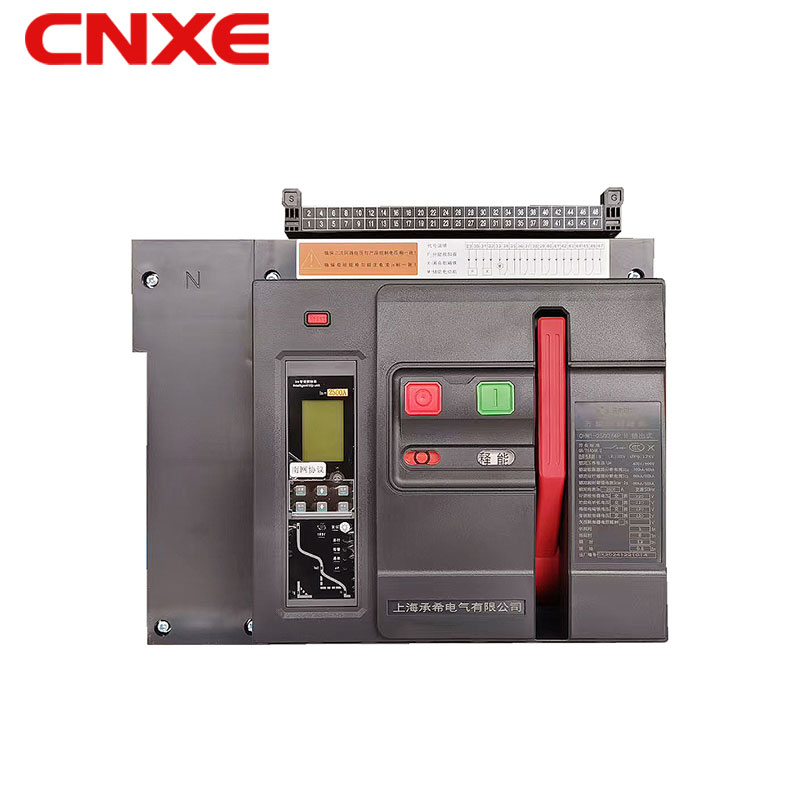
The page describes the unit as PC class with high short-circuit withstand capability. In practice, this means the switch can close onto and carry a short-circuit current for a short time without being damaged, but it has no overcurrent trip of its own. Clearing the fault is the job of the circuit breakers upstream. For the buyer, that makes the withstand rating and the upstream breaker a pair that has to be checked together against the fault level at the board. A PC-class ATS with a matching breaker upstream is a common layout in buildings where the distribution board already has protection on both supply lines. Where the withstand figure and the breaker rating are not documented side by side, the question goes to the factory before the cabinet is built. Any Dual Power Automatic Transfer Switch of this class should arrive with both figures documented.
A Dual Power Automatic Transfer Switch built this way has three stable positions: main supply, off and backup supply. The middle position is what makes the device useful for maintenance, because with the switch there neither source reaches the load, and the circuit downstream can be isolated and worked on. The page describes this as complete isolation, and for a maintenance team, a dual power ATS with a real off position is easier to lock out. Operation can be automatic or manual, and the controller reacts to power failure, phase loss and abnormal voltage on the main supply. Generator control is also listed, so the same dual-power automatic transfer switches can start the standby set and take the load once it is ready.
The model table lists each of the four sizes twice, once as Standard and once as Fire Linkage, and every one has a built-in controller. The fire linkage versions accept a signal from the fire alarm system, and what the switch does on that signal, for example, which source stays connected, is set by the project's fire strategy rather than by the switch alone. That is a design decision to write down before ordering a Dual Power Automatic Transfer Switch with fire linkage. Fire protection systems, hospitals, high-rise buildings, data centres, production lines and shopping malls are the places the page names, and in many of them the fire linkage question is part of the same conversation as the rating. Chengxi Electric Group lists both versions side by side, so the choice can follow the project's fire strategy.
A rating that fits the load, a fault rating that matches the breaker, and a fire signal that is wired the way the designer intended: those three checks cover the usual weak points of a Dual Power Automatic Transfer Switch order.
 The company is committed to providing high-quality electrical products and excellent customer service. We not only supply exquisite, top-tier products to meet your needs but also back them with a sincere and comprehensive after-sales service guarantee.
Contact Us
 +86-18067486879
 [email protected]
 281 Wei 15th Road, Yueqing Economic Development Zone, Zhejiang, China
Copyright © Chengxi Electric Group Co., Ltd. All Rights
Reserved

High Voltage Transformer & Electrical Circuit Breaker Factory




 English
 Français
 中文简体
 русский
 Español
 عربى